Why lighting matters in a bathroom
Lighting is one of the most overlooked parts of a bathroom renovation, yet it shapes how the room looks and how well it works every day. A single ceiling light in the middle of the room, the arrangement in most older Morwell bathrooms, casts shadows on the face at the mirror, leaves the shower dim and makes even new tiles look flat. Good lighting makes shaving, applying make-up and cleaning easier, shows off the finishes you have chosen and can make a small room feel larger.
The Latrobe Valley’s short, grey winter days make this even more important. For several months of the year, many people shower and get ready before sunrise and after sunset. A well-lit bathroom makes those mornings and evenings far more pleasant.
This guide explains how to plan lighting for a bathroom, ensuite, powder room or laundry, and what to think about before the walls are lined.
Plan lighting in layers
Designers talk about three layers of light. Using all three gives a bathroom that works well and feels comfortable.
Ambient light
Ambient light is the general light that fills the room. In most bathrooms this comes from ceiling downlights or a ceiling fitting. Spread downlights evenly rather than putting a single light in the centre, and make sure the shower receives its share. A light directly over the shower, rated for wet areas, avoids a dim corner.
Task light
Task light is focused on where you need to see clearly, mainly the mirror. The best task light comes from beside or around the face, not from directly above. Overhead light at the mirror throws shadows under the eyes, nose and chin. Options include:
- Wall lights on either side of the mirror at roughly face height.
- A mirror or shaving cabinet with integrated LED lighting around the edge.
- A long horizontal light above the mirror, combined with side light.
Accent light
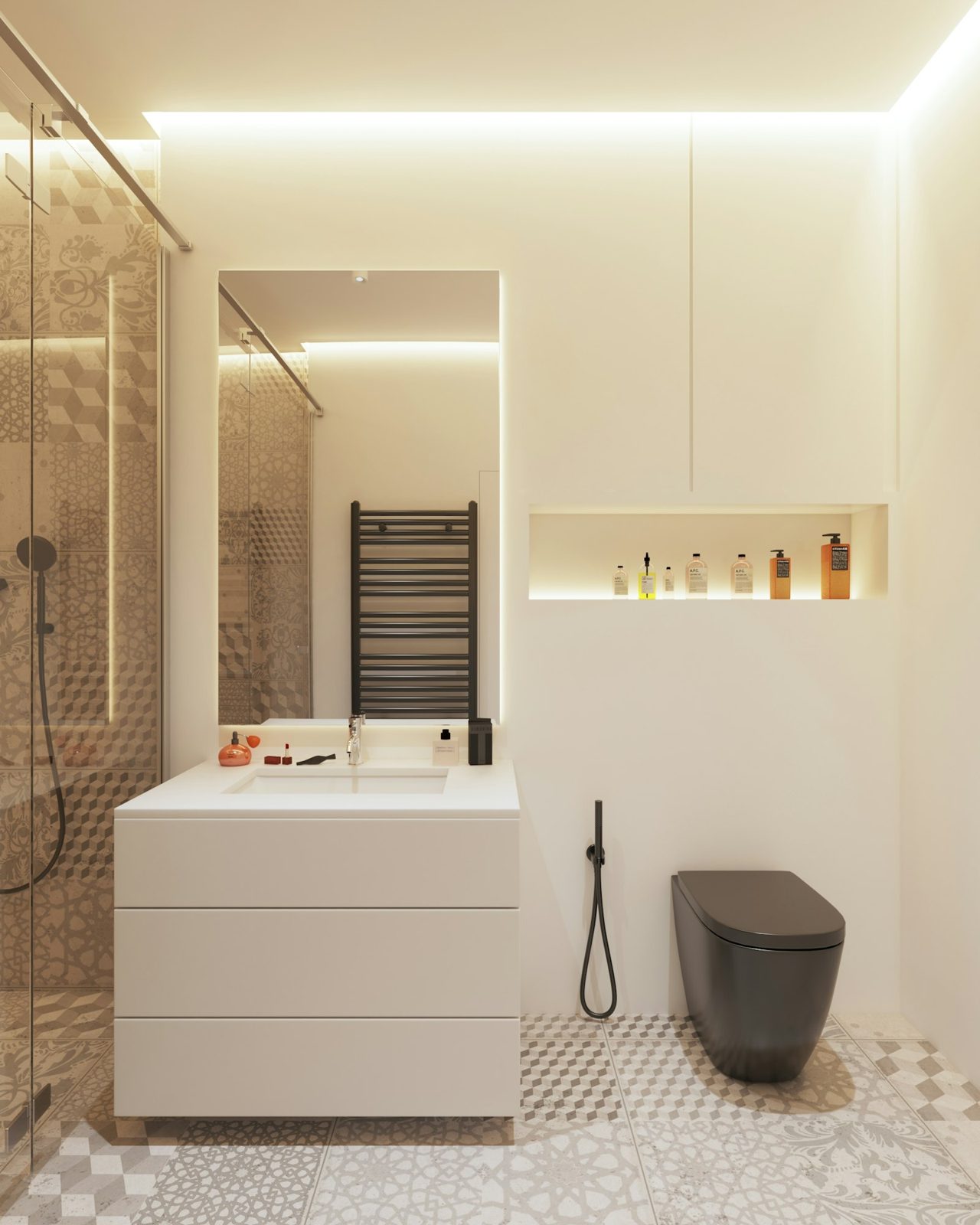
Accent light adds atmosphere and highlights features. Examples include an LED strip under a floating vanity, lighting in a shower niche, a strip behind a mirror that washes the wall, or a pendant in a powder room. Accent lights on a separate switch or dimmer give a soft night light and a relaxing mood for a bath.
Colour temperature
LED lights come in different colour temperatures, measured in kelvin.
- Warm white (around 2700 to 3000K) gives a cosy, soft light similar to old incandescent globes.
- Neutral white (around 4000K) is crisp and clear, and shows colours accurately.
- Cool white (5000K and above) can feel clinical in a home bathroom.
For most bathrooms, neutral white at the mirror, where you need to see skin tones accurately, works well, with warm white for ambient or accent light. Whatever you choose, keep the colour temperature consistent within each layer, because mixing warm and cool fittings looks patchy.
Colour rendering
The colour rendering index, or CRI, measures how accurately a light shows colours. A higher number, ideally 90 or above, makes skin tones, make-up and tile colours look true. It is worth checking for mirror lighting in particular.
Wet-area zones and safety
Electrical fittings in bathrooms must suit their location. The area in and around the shower and bath is divided into zones, and fittings in these zones must have an appropriate ingress protection rating against water. Switches and power points must be kept a safe distance from the shower and bath. All electrical work must be done by a licensed electrician to the wiring rules, and we coordinate this with our electrician as part of every renovation.
Natural light
Many older Morwell bathrooms have a single window, often above the bath or toilet, with frosted glass. When renovating, consider whether the window can be enlarged, raised for privacy, or replaced with a highlight window near the ceiling. A skylight or roof window can bring daylight into an internal ensuite. Natural light makes a room feel fresher and helps it dry out, but windows inside a shower need careful detailing to avoid leaks and must use safety glass.
Frosted or patterned glass, or a privacy film, keeps light while preserving privacy. Sheer blinds or plantation shutters suited to wet areas are also options.
Lighting for different rooms
Family bathrooms
Family bathrooms need bright, even light for bathing children and cleaning, plus good mirror lighting for adults getting ready. A dimmer or separate night light helps for late-night visits.
Ensuites
Ensuites benefit from softer lighting that will not dazzle someone in the adjoining bedroom. A low-level light under the vanity or a sensor light at floor level guides the way at night without waking a partner.
Powder rooms
Powder rooms are a good place for a decorative pendant or wall lights. Because guests use them, make sure there is enough light to wash hands and check the mirror.
Laundries
Laundries need bright, practical light over the bench and tub, and good light to sort clothes and check stains. Under-cabinet strip lights are useful.
Switching and controls
Plan switches for convenience.
- Put the main light switch outside the door or just inside it, easy to find in the dark.
- Separate switches for ambient, mirror and accent lights let you choose the mood.
- Link the exhaust fan to the light with a run-on timer, so it keeps running after you leave.
- Consider a motion sensor for a night light.
- Dimmers on ambient lights suit relaxing baths.
Lighting and heating combined
Some ceiling units combine a light, an exhaust fan and a heater. These save ceiling space and suit small bathrooms. In larger rooms, separate fittings usually give better results. Infrared heat lamps warm people quickly but can be harsh to look at; panel heaters and heated towel rails give gentler warmth.
Mirror demisters
A mirror demister is a heating pad behind the mirror that keeps it clear of condensation. It is wired to the light or fan switch and is very useful in the Latrobe Valley, where cold mornings fog every mirror.
Planning before the walls are lined
All wiring for lights, switches and demisters must be in place before the walls and ceiling are lined. Changing your mind later means cutting into new tiles or plaster. Decide on lighting during the design stage, mark positions on the drawings, and check them on site before the plasterer arrives.
Mistakes to avoid
- A single central light that leaves the mirror and shower in shadow.
- Downlights directly above the mirror, which cast shadows on the face.
- Mixing warm and cool fittings.
- Lights over the shower that are not rated for wet areas.
- Forgetting a night light.
- A switch that is hard to find in the dark.
- Too few lights in a room with dark tiles, which absorb light.
Energy efficiency
LED fittings use far less power than older halogen or incandescent globes and last much longer. A well-planned LED scheme lights the room better while using less electricity. Linking the fan and lights to sensors or timers prevents them being left on.
Lighting and your finishes
The finishes you choose affect how much light the room needs. Dark tiles, matte surfaces and timber-look vanities absorb light, so they need more fittings. Light-coloured tiles and gloss surfaces reflect light, brightening the room. Gloss tiles can also show reflections of downlights, which some people like and others find distracting.
When choosing tiles, look at samples under the type of light you plan to install. Colours look very different under warm and neutral light.
Lighting post-war bathrooms
Post-war bathrooms in Morwell and Moe typically have a single ceiling light, often in an old fitting, and a small window. When renovating, we replace the old fitting with evenly spaced downlights, add mirror lighting, and consider a larger or better-positioned window.
Lighting brick veneer bathrooms
Brick veneer bathrooms from the 1980s often have a fluorescent tube above the mirror or a bank of halogen downlights. Replacing them with LED fittings improves the light and reduces power use.
Lighting walk-in showers
A walk-in shower should have its own light, rated for wet areas. A niche light adds atmosphere and helps you find bottles.
Lighting for older eyes
As we age, we need more light to see clearly, and glare becomes more of a problem. Bright, even, glare-free light, good contrast and night lights help older people use the bathroom safely.
How many downlights does a bathroom need?
It depends on the room size and finishes; we plan the number and spacing at the design stage.
Can mirror lighting replace downlights?
It provides task light, but most bathrooms also need ambient light.
Is a pendant safe in a bathroom?
Yes, if positioned outside the wet zones and installed by a licensed electrician.
What is a good night light?
A low-level LED strip under the vanity or a sensor-activated light near the floor.
Lighting across the district
We plan lighting as part of every renovation in Morwell, Traralgon, Churchill, Moe and nearby towns, coordinating with our licensed electrician.
Lighting and safety at night
Night-time trips to the bathroom are when many falls happen, especially for older people. A low-level sensor light that turns on automatically, a light switch near the bed or doorway and a clear path to the toilet all reduce the risk. Avoid bright lights at night, which can disturb sleep.
Lighting zones and safety
Wiring rules divide a bathroom into zones around the shower and bath, and each zone limits which fittings can be installed. Fittings close to water need a suitable IP rating, which shows how well they resist moisture. Our licensed electricians select fittings rated for each position and install them to the rules, with power points and switches placed at safe distances from water.
Light colour and tiles
The same tile can look quite different under warm and cool light. Before finalising selections, look at samples under light similar to what you plan to install. Warm light enhances timber, terracotta and cream tones, while neutral light shows greys and whites more accurately.
Dimmers and scenes
A dimmer lets bright light for cleaning and shaving soften to a gentle glow for a relaxing bath. Separate switching for the mirror, ceiling and feature lights gives you flexibility without complicated controls.
Do LED lights suit bathrooms?
Yes. LED fittings run cool, use little power and last a long time, which suits a room where lights are switched on and off often.
Book a design consultation
If you are planning a bathroom renovation in Morwell or a nearby town, book a design consultation. We will plan the lighting together with the layout, so every part of the room is well lit.
Our bathroom services
- Accessible Bathrooms
- Bathroom Design
- Bathroom Renovations
- Bathroom Tiling
- Ensuite Renovations
- Laundry Renovations
- Leaking Shower Repairs
- Powder Room Renovations
- Shower Conversions
- Small Bathroom Renovations
- Vanity and Storage
- Waterproofing
Book a design consultation
Tell us about your bathroom, ensuite or laundry and we will visit to measure, talk through ideas and prepare a clear written scope.
Book a design consultation